
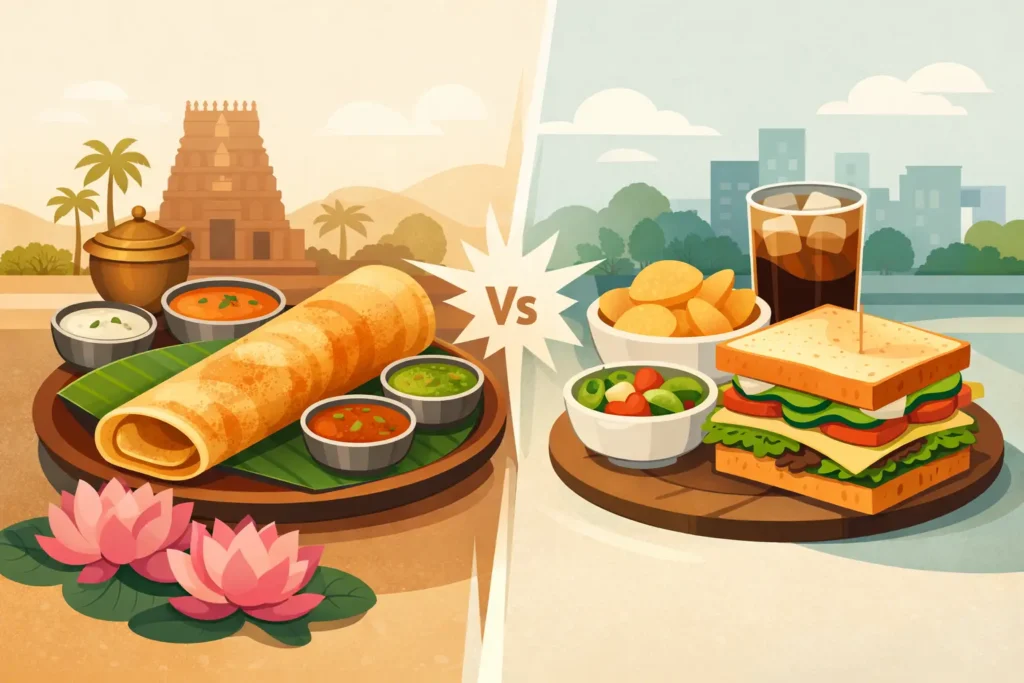
Some lunches get chosen by the clock. Others get chosen by the craving. That is exactly why the dosa vs sandwich lunch debate keeps showing up on busy workdays, college breaks, and those in-between afternoons when you want something fast but still worth eating.
A sandwich feels easy, familiar, and built for multitasking. A dosa feels warm, satisfying, and a little more like a real pause in the day. Neither is automatically better every single time. The right pick depends on how hungry you are, how much flavor you want, and whether lunch needs to travel with you or give you a proper sit-down moment.
Dosa vs sandwich lunch – what are you really choosing?
At first glance, this sounds like a simple carb-on-carb comparison. It is not. You are really choosing between two very different lunch experiences.
A sandwich is usually about speed and convenience. It is compact, easy to carry, and quick to eat between classes, meetings, or errands. It fits the grab-and-go rhythm that a lot of people live in.
A dosa brings something else to the table. It is crisp on the outside, soft where it folds, and built to be eaten with chutneys and sambar that change every bite. It feels more layered, more comforting, and often more memorable. Lunch stops being just fuel and starts feeling like an actual meal.
That difference matters. When your day is packed, convenience wins. When your mood wants warmth, texture, and real flavor, a dosa can hit harder than a basic handheld option.
Flavor is where dosa usually pulls ahead
A good sandwich can absolutely be satisfying, especially if it has fresh vegetables, a bold spread, good bread, and some crunch. But sandwiches often rely on one dominant flavor profile. Once you understand the filling, you have understood most of the meal.
A dosa plays a different game. The dosa itself has a lightly tangy, toasted character. Then come the chutneys, each adding its own personality. Sambar brings warmth and depth. If there is masala inside, that adds another layer of comfort and spice. Every dip changes the bite.
So in the dosa vs sandwich lunch conversation, dosa often wins on flavor range. It feels more dynamic. You are not just eating one thing. You are moving between crisp, soft, spicy, savory, and soothing all in the same plate.
For people who get bored easily with lunch, that matters. A meal with contrast feels less routine, which is probably why dosas stay such a strong comfort choice even in fast-paced food scenes.
Sandwich wins when life is moving fast
This is where the sandwich deserves real respect. If lunch has to happen while walking across campus, riding in a cab, or jumping from one task to the next, a sandwich is built for that moment.
It is neater. It is easier to pack. It usually asks less from you in terms of setup, dipping, or table space. You can eat it with one hand and keep the day going.
That makes sandwich lunch a practical hero for students and young professionals who are managing more than one thing at once. It is not always the most exciting choice, but it is dependable. And on certain days, dependable is exactly what you need.
The trade-off is that convenience can flatten the experience. If the bread is dry or the filling is skimpy, lunch can feel more functional than satisfying. A sandwich has less room to hide. When it is good, it is great. When it is average, you know immediately.
Fullness is not just about size
People often assume the bigger-looking meal is the more filling one. That is not always true.
A sandwich can feel light and efficient, especially if it is simply built. That can be a good thing if you want lunch without the post-meal slowdown. But depending on the ingredients, some sandwiches leave you reaching for a snack an hour later.
A dosa often gives a deeper sense of satisfaction because of the full meal experience around it. The combination of dosa, chutneys, and sambar creates more variety and volume. It feels complete. You are not just finishing a quick bite. You are settling a craving.
That said, it depends on the portion and style. A light plain dosa may feel less filling than a loaded sandwich with cheese and vegetables. A masala dosa with sides may keep you going much longer. So if your main question is which one has more staying power, the answer is not dosa or sandwich by default. It is about how each one is prepared.
Mood matters more than people admit
Lunch is not only about nutrition or convenience. It is also about what kind of day you are having.
If you are stressed, tired, or mentally done by 1 p.m., a dosa can feel like comfort with texture. It has warmth. It has aroma. It asks you to slow down for a few minutes. That is a very different emotional payoff from eating a sandwich at your desk.
If your day is social, casual, and moving, a sandwich can fit right in. It works for quick catch-ups, library breaks, and lunch that does not need ceremony. It keeps the vibe light.
This is why the dosa vs sandwich lunch question has no one-size-fits-all answer. Some days you want a quick fix. Some days you want a plate that feels like a reset button.
Which lunch works better for students and office goers?
For students, the answer often comes down to schedule and budget. A sandwich works well when there is a short break between classes and no time for a full sit-down meal. It is easy, fast, and familiar. But when there is enough time to actually enjoy lunch, dosa usually feels more rewarding because it brings stronger flavor and a more complete mealtime feel.
For office goers, the choice depends on whether lunch is happening at your desk or away from it. A sandwich suits the desk-lunch crowd. It is tidy and efficient. A dosa is better when you can step away from your screen and want something that breaks the workday monotony.
That is part of why places like Avant-Aroma resonate with urban lunch crowds. The menu understands that cravings shift. Some days call for the comfort of South Indian classics. Other days lean toward toast, bowls, or snack-style picks. Real lunch habits are not fixed. They move with your mood.
If you care about experience, dosa has an edge
There is a reason some meals become habits and others stay backups. Experience matters.
A sandwich can be solid, but it rarely feels theatrical unless it is specially built. A dosa naturally has presence. The crisp fold, the steam when it opens, the color of the chutneys, the first dip into sambar – it creates a moment. That sounds small, but it changes how lunch feels.
For food lovers, that sensory difference is a big deal. You remember a lunch that gave you contrast, aroma, and comfort. You talk about it. You go back to it.
That does not mean sandwich lunch has no personality. A really good one can bring crunch, freshness, and bold sauces in a very satisfying way. But if the goal is a more expressive lunch, dosa usually carries more flavor culture in every bite.
So, what should you pick today?
Choose a sandwich when you need speed, portability, and a lunch that keeps up with your schedule. It is the smart move for packed afternoons, quick errands, and no-fuss eating.
Choose a dosa when you want lunch to actually feel like lunch. It is the better pick when flavor matters, comfort is calling, and you want something that gives your day a little more soul.
The best answer to dosa vs sandwich lunch is not about declaring one winner forever. It is about reading the moment. If your afternoon needs convenience, go handheld. If it needs warmth, crunch, and a proper craving fix, go for the dosa. The right lunch is the one that matches your energy and leaves you glad you did not settle.